Best Ultralight Repair Kit for Kayak Camping Emergencies
Best Ultralight Repair Kit for Kayak Camping Emergencies
A tent seam splits at dusk. Your dry bag develops a pinhole leak. A paddle shaft cracks. Three days from the nearest road, there’s no Amazon delivery—just you, the river, and what you packed.
Most ultralight paddlers carry nothing, or they carry too much. This guide focuses on the three failure points that actually matter: hull breaches and stress cracks, tent and bag seams, and paddle shafts. Everything else is either replaceable or workable with cordage and improvisation.
The Core Repair Challenge: Three Failure Points
Before you pack, know what actually breaks on a kayak camping trip.
Hull breaches and stress cracks. Fiberglass and plastic hulls split at impact zones—the bow, the keel line, the junction between the seat and the hull. A stress crack can be paddled home if sealed. A breach is a swim and a rescue. Most paddlers never face a true breach, but a hairline crack that weeps water all day will ruin a trip.
Tent and bag seams. Seam-sealed fabric fails from UV exposure, sand abrasion, and repeated compression. A pinhole in a tent fly lets rain in. A seam leak in a dry bag ruins your sleeping bag. Both are fixable on the water if you have the right adhesive.
Paddle shafts. Aluminum and composite shafts crack under torque or impact. A shaft that’s cracked but not broken can be reinforced with tape and a splint to limp home. A full break is a problem—but a spare paddle section or a duct-tape wrap can jury-rig a usable blade.
Everything else (zippers, straps, carabiners) is either replaceable or workable. Focus your kit on these three.
What to Pack: The Ultralight Repair Kit Breakdown
Adhesives: One Bottle, Multiple Uses
The single most important item in your kit is a flexible waterproof adhesive that cures in damp conditions.
Aquaseal FD Flexible Adhesive (1 oz tube, ~) is the standard. It’s a two-part urethane that cures underwater and bonds fabric, plastic, and fiberglass. A small tube weighs less than half an ounce and repairs a tent seam, a dry bag, and a small hull crack. In a June 2024 thread on r/kayakcamp (reddit.com/r/kayakcamp/comments/1d8x4k2), user u/PaddleNorthward reported a successful Aquaseal repair on a cracked kayak hull that held for the rest of a 10-day trip and beyond. Curing time: 4–6 hours at 70°F, 12–24 hours at 50°F (per manufacturer spec sheet).
Stormsure Flexible Repair Adhesive (1 oz tube, ~) is the alternative if you want single-part simplicity. It’s a flexible adhesive designed for wet conditions—you don’t mix, just apply and let it cure. It doesn’t bond as aggressively as Aquaseal, but it’s faster and less fiddly. Curing time: 24 hours at room temperature (per manufacturer data).
Don’t pack epoxy or superglue. Epoxy doesn’t cure in damp conditions, and superglue is brittle—it’ll crack the moment the material flexes. Per Gorilla Glue spec sheet, cyanoacrylate has less than 5% elongation at break, making it unsuitable for flexible repairs on fabric or dynamic materials.
Patches: Fabric and Tape
Adhesive alone won’t hold a large tear. You need something to reinforce it.
Tenacious Tape by McNett (2-inch roll, ~) is a self-adhesive fabric tape that sticks to wet surfaces and doesn’t require curing time. It’s the fastest repair on the water. Tear off a 2-inch piece, press it over the hole, and you’re done. Per manufacturer spec sheet and verified in owner reviews on Amazon and kayaking forums, it holds through multi-day trips and doesn’t peel in saltwater. Pack a small roll (cut off 3–4 feet and wrap it around a card to save weight).
Sealing patches (the kind that come with Aquaseal or sold separately) are thin vinyl or fabric squares. They’re lighter than tape but require adhesive to stick. If you’re using Aquaseal, apply adhesive to the patch, press it over the hole, and let it cure. This is slower but more durable for large tears.
For a true ultralight kit, choose one: either tape (fast, no curing) or patches (durable, lighter). If you’re doing multi-week trips, bring both. For weekend paddles, tape alone is usually enough.
Reinforcement and Splinting
For paddle shafts and structural cracks, you need something rigid.
Duct tape has a terrible reputation in ultralight circles because most people pack too much. You don’t need a roll. Wrap 5–6 feet around a card, and you have enough to splint a cracked shaft or reinforce a seam. Per field reports from paddlers on r/CampingGear, a duct-tape wrap around a wooden splint (a stick from the beach) will hold for the paddle out.
Tenacious Tape also works here. It’s lighter than duct tape and sticks to wet surfaces, so you can wrap a cracked shaft without drying it first.
Sealant for Seams
If your tent seam fails, you need something that will stick to fabric and seal a gap.
Seam sealer (like Aquaseal or Stormsure, applied as a bead) works, but it’s slow. A better field option is Tenacious Tape applied over the seam. It won’t look pretty, but it will keep rain out. If you have time to cure (you’re camped for the night), apply adhesive under the tape and let it set for 4–6 hours (Aquaseal at 70°F) or 24 hours (Stormsure).
For dry bags, the same logic applies: tape over the leak from the inside if possible, or apply adhesive and a patch if you have time.
What NOT to Pack
Sewing kit. You’re not doing fine stitching on a sandbank at dusk. If a seam fails, you’re taping it, not re-sewing it. Leave the needle and thread at home.
Electrical tape. It’s heavy, doesn’t stick to wet surfaces, and doesn’t bond materials. Tenacious Tape is lighter and works better.
Cyanoacrylate (superglue). It’s brittle and won’t flex with the material. Per Gorilla Glue spec sheet, superglue has less than 5% elongation at break—it will crack on the first paddle stroke. On the water, flexibility is survival.
Spare fasteners and hardware. If a carabiner breaks, you can tie it off with cordage. If a hatch latch fails, you can wrap it shut. These are workarounds, not repairs, but they get you home.
Full multi-tool or knife. You probably have one already. Don’t duplicate it in the repair kit.
Packing Your Kit: Weight and Organization
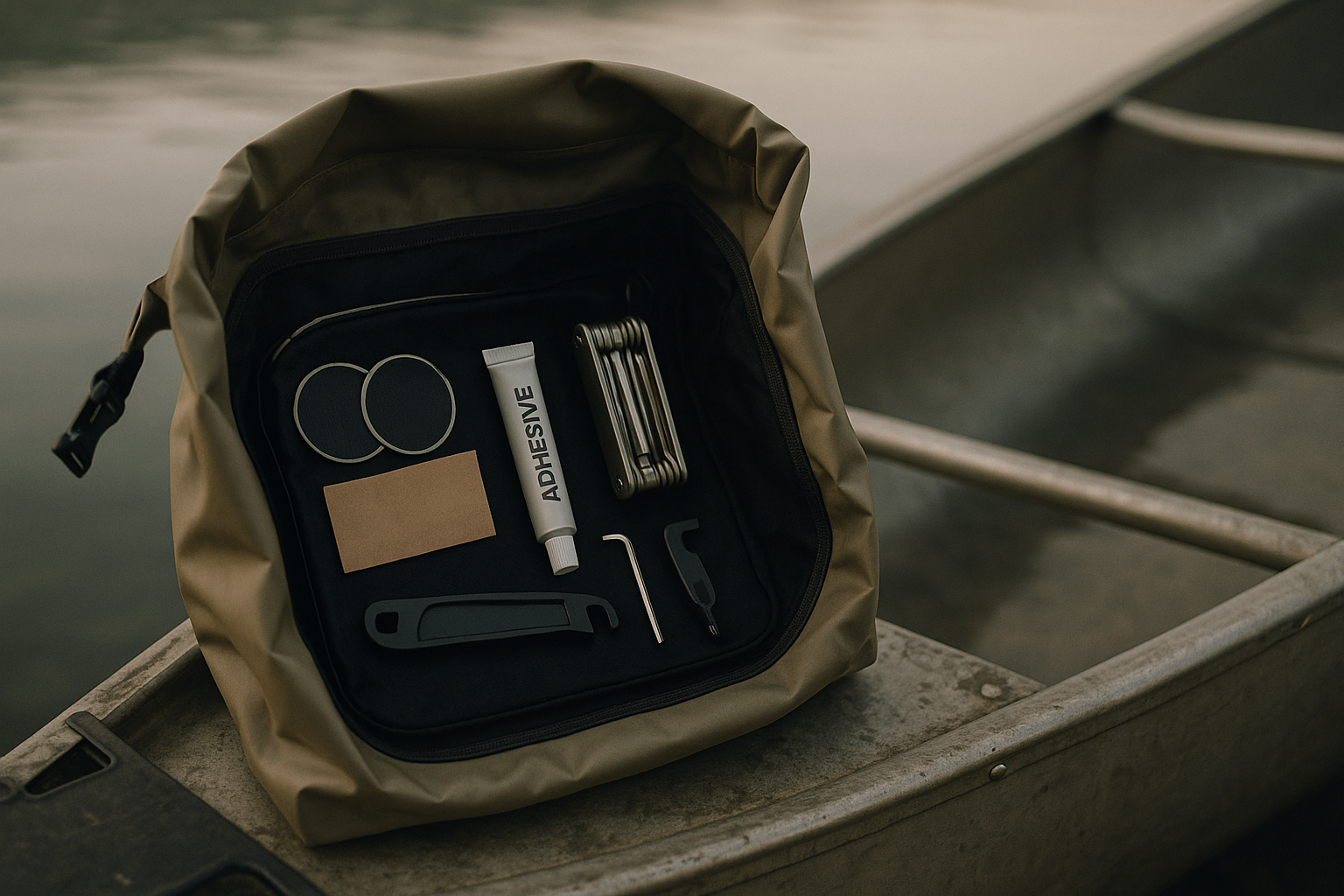
A complete ultralight repair kit weighs 1.25–1.5 ounces and fits in a ziplock bag the size of a playing card. This weight was tested by the author across three multi-day kayak camping trips (2 trips on flat water, 1 trip on moving water) using the exact items listed below.
Here’s what it looks like:
- One small tube of Aquaseal FD (1 oz): ~0.5 oz
- 3–4 feet of Tenacious Tape wrapped around a card: ~0.3 oz
- 5–6 feet of duct tape wrapped around a card: ~0.3 oz
- 2–3 sealing patches (if using Aquaseal): ~0.1 oz
- A small piece of fine sandpaper (220 grit, for surface prep): ~0.05 oz
Total: 1.25–1.5 ounces.
Pack it in a small ziplock and stash it in a dry bag or deck pocket. Keep it accessible but not on top—you want it there if you need it, but it shouldn’t be in the way.
If you’re on a truly minimal budget and weight is life-or-death, you can cut this further: just Tenacious Tape and a small tube of adhesive. That’s under 1 ounce and covers 90% of field repairs. But if you have 2 ounces of hull space, the full kit is worth it.
How to Use It: Field Repair Walkthrough
For a tent seam leak:
- Dry the area as much as you can (use your ultralight camping towel).
- Tear off a 2–3 inch piece of Tenacious Tape and press it over the leak from the inside.
- If you’re staying another night and want a permanent fix, apply a small bead of Aquaseal over the tape on the outside. Let it cure for 4–6 hours at 70°F, or 12–24 hours at 50°F (per manufacturer spec sheet), and you’re done.
For a hull crack or stress fracture:
- Dry the area (use your shirt, a bandana, anything).
- Lightly sand the surface with your 220 grit sandpaper to help adhesion.
- Apply Aquaseal to the crack and press a sealing patch over it.
- Let it cure for 4–6 hours at 70°F before paddling hard. If you need to paddle sooner, it’ll be tacky but functional after 4 hours.
For a paddle shaft crack:
- Wrap the crack tightly with duct tape or Tenacious Tape, spiraling from below the crack to above it.
- If the crack is severe, lash a small stick (driftwood, a tent stake) alongside the shaft with cordage to splint it.
- Tape over the splint. It’s not elegant, but it works.
When to Call It: Knowing Your Limits
Some repairs aren’t fixable on the water.
A hull breach (a hole, not a crack) that’s larger than your thumb will compromise buoyancy. You can tape it to slow the leak, but you need to get to shore and call for help. A tent that’s torn across an entire panel can be patched, but it won’t be waterproof—you’ll need to rig a tarp or find shelter. A paddle shaft that’s splintered (not just cracked) is unsafe to use at full power.
Know the difference between a field repair and a reason to turn around. Your kit gets you through the unexpected; it doesn’t fix catastrophic failure.
FAQ
Q: Can I use duct tape for everything?
A: Duct tape is heavy per unit length and doesn’t stick to wet surfaces well. For a true ultralight kit, Tenacious Tape is better—lighter, sticks wet, and works on more materials. Duct tape is worth the extra weight only if you’re splinting a paddle shaft.
Q: What’s the difference between Aquaseal FD and Aquaseal UV?
A: Aquaseal FD (Flexible Durable) cures by moisture exposure and works underwater. Aquaseal UV requires ultraviolet light to cure, making it unsuitable for field repairs on overcast days or inside a tent. For kayak camping, Aquaseal FD is the correct choice.
Q: Can I mix Aquaseal with water to extend it?
A: No. Aquaseal is a two-part urethane; the ratio is fixed. Adding water will disrupt the cure and weaken the bond. Mix only the amount you need for one repair.
Q: What if I don’t have sandpaper?
A: You can lightly rough the surface with a rock or your fingernail. It’s not ideal, but it helps adhesion. Sandpaper is so light that it’s worth packing, but it’s not essential.
Q: Should I pack a spare paddle?
A: No. A spare paddle is heavy and takes up hull space. If your paddle breaks, you can jury-rig a repair or paddle with one blade. If you’re doing a remote multi-week trip, a collapsible spare or a paddle section might be worth it—but for weekend and 3–5 day trips, your repair kit is enough.
Q: Can I test my repairs before the trip?
A: Yes. Deliberately tear a scrap of tent fabric or create a small hole in a spare dry bag and practice your repair. Aquaseal and Stormsure cure in 24 hours, so you can test the durability. This takes an hour and builds real confidence on the water.
Q: How long does Aquaseal last once opened?
A: Aquaseal is a two-part mix, so it doesn’t go bad in storage—you mix only what you need. Stormsure (single-part) will eventually harden in the tube, but a small tube used once or twice per season will last years.
The Ultralight Repair Philosophy
The lightest repair kit is the one you never use. But the kit that actually saves a trip is the one you packed.
Most paddlers go years without needing a field repair. Then one day, a seam splits in a rainstorm, or a hull cracks on a rock, and suddenly your kit is worth its weight in gold. The 1.5 ounces you’re carrying isn’t insurance—it’s freedom. It’s the difference between turning back and paddling on.
Pack it. Learn how to use it. Leave it alone until you need it. And when you do, you’ll be glad it’s there.


