Best Ultralight Dry Suit Alternatives for Kayak Camping in 2026

Photo by roya ann miller on Unsplash
Ultralight Dry Suit Alternatives for Kayak Camping
A full dry suit is heavy, expensive, and overkill for most paddle-camping trips. You’re not running whitewater; you’re drifting sandbanks and sleeping under stars. What you need is selective waterproofing — protection where water actually threatens you, without carrying a rubber cocoon that takes up half your hull space and costs as much as a decent tent.
This guide breaks down the real alternatives: layering systems, splash jackets, neoprene tops, and hybrid rigs that keep you dry where it matters, stay light enough to pack, and won’t blow your ultralight budget.
Why Skip the Dry Suit for Paddle Camping
A traditional dry suit — the kind with latex seals and a watertight zipper — serves whitewater paddlers who expect repeated immersion and need to stay warm in a capsize. That’s not your trip.
On a kayak camping expedition, you’re moving slowly, staying upright, and sleeping dry on shore. Your immersion risk is low: a splash over the bow, maybe a clumsy re-entry after a lunch break, the occasional lean into a standing wave. Full waterproofing from neck to ankles is weight you don’t need and money you can redirect toward shelter, sleep system, or food.
A dry suit also traps heat and moisture — you’ll sweat inside it on a warm summer paddle, and peeling it off on a narrow gravel bar is awkward. For a multi-day trip, you want breathability and flexibility. You want to shed water without becoming a mobile sauna.
The ultralight alternative is strategic waterproofing: protect your core and upper body where splashes land, let your legs get wet (they dry fast in sun and wind), and layer underneath so you stay warm even if water gets through.
The Core Alternatives
Splash Jackets and Paddling Shirts
A splash jacket is a lightweight, water-resistant shell designed for paddling. It covers your torso and arms — the areas most exposed to spray — without the sealing requirements of a dry suit.
What they do: shed water, block wind, and breathe better than a full dry suit. Most are made from nylon or polyester with a water-repellent coating (DWR), not a fully sealed seam.
Weight: typically 8–14 oz for a mid-weight jacket, depending on fabric thickness and coverage.
When they work: warm-water trips, protected rivers, summer paddling where the air is warm enough that a soaking doesn’t risk hypothermia. Per paddler reports on Reddit’s r/kayaking, splash jackets work wet for several hours before water penetrates seams.
Trade-off: they’re not waterproof in heavy rain or a prolonged dunking. Water will eventually seep through seams and fabric if you’re immersed. For kayak camping, that’s fine — you’re not planning to swim.
Popular options include Stohlquist Splash Jacket and 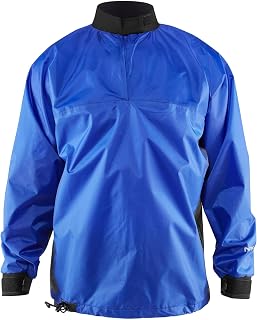
Neoprene Tops and Vests
Neoprene is dense, buoyant, and naturally water-resistant. A thin neoprene top (0.5mm to 1.5mm) sheds splashes, insulates even when wet, and weighs less than you’d expect.
What they do: provide thermal protection and water shedding in a single layer. Per NRS testing, neoprene insulates even when wet because water trapped in the material warms against your skin and the closed-cell structure retains heat. It just works without special sealing or maintenance.
Weight: a 0.5mm neoprene top runs 10–16 oz; thicker versions (1.5mm) push toward 20 oz but offer better insulation.
When they work: cool-water trips, multi-day expeditions where you might get wet and need to stay warm, and situations where you’re happy to wear the same layer for the entire paddle.
Trade-off: neoprene is less breathable than shell jackets. You’ll feel the sweat on a hot, flat paddle. It also takes longer to dry if you remove it — plan to wear it the whole day or accept that it’ll stay damp.
NRS Hydroskin 0.5mm Jacket is the ultralight neoprene standard: thin enough to pack easily, warm enough to protect, and affordable.
Gore-Tex and Breathable Waterproof Shells
Gore-Tex (and similar breathable membranes like eVent) are the gold standard for paddling jackets. They’re fully waterproof but let moisture vapor escape, so you don’t sweat as much as you would in a sealed dry suit.
What they do: provide true waterproofing while remaining breathable. Seams are taped, zippers are waterproof, and the fabric itself sheds water.
Weight: 12–20 oz depending on construction and coverage.
When they work: cold-water trips, extended rain, situations where you need real waterproofing but don’t want the heat penalty of a dry suit.
Trade-off: cost. A Gore-Tex paddling jacket runs. They’re also less forgiving than neoprene — seams can fail, zippers can jam, and you need to care for the DWR coating.
Kokatat Gore-Tex Paddling Jacket is the benchmark. It’s expensive, but the waterproofing and breathability are genuine.
Ultralight Rain Shells
For pure minimalism, a packable rain shell — the kind backpackers use — weighs almost nothing and packs to fist-size. Frogg Toggs Ultra-Lite Rain Jacket is the classic: 3–5 oz, bright yellow, and waterproof enough for a sudden downpour.
What they do: shed rain and splash. They’re not designed for paddling, but they work in a pinch.
When they work: as a backup layer, for warm-water trips where you don’t expect immersion, or as emergency shelter if the weather turns.
Trade-off: they’re fragile. Repeated paddling will tear them. They also don’t vent well — you’ll get clammy inside. Think of it as a backup, not your primary layer.
Layering for Thermal Protection
The real secret to staying warm without a dry suit is layering underneath. Your splash jacket or neoprene top is just the outer barrier; the insulation comes from what’s underneath.
Base Layer: Merino or Synthetic
Start with a moisture-wicking base layer. Merino wool dries faster than cotton and stays warm even when damp. Synthetic (polyester, nylon) is cheaper and equally effective.
A long-sleeve merino top adds almost no weight and makes the difference between “chilly” and “comfortable” on a cool-water paddle.
Mid-Layer: Fleece or Down
If the water is cold, add a thin fleece or down layer under your splash jacket. A lightweight fleece (8–12 oz) or a compact down vest (6–10 oz) traps air and keeps you warm.
The key: choose something that dries quickly or packs small when wet. A synthetic fleece dries faster than wool; a down vest packs to the size of a grapefruit.
Outer Layer: Your Splash Jacket or Neoprene Top
This is your waterproof barrier. It doesn’t need to be heavily insulated — the layers underneath do that work.
Hybrid Approaches: Mixing and Matching
Most ultralight paddle campers don’t stick to one solution. Instead, they mix based on conditions:
- July paddle on a 65°F river, 3-day trip, no whitewater: merino base + splash jacket + packable rain shell backup.
- September expedition on a 55°F lake, 5 days, overnight camps: merino base + synthetic fleece + neoprene top.
- May paddle on a 48°F northern river, 10-day trip, potential cold nights: merino base + down vest + Gore-Tex shell + rain backup.
The flexibility is the point. You can peel layers as the day warms, add them as the sun drops, and adjust based on conditions. A dry suit locks you into one thermal profile; layering adapts.
Drying and Durability
One advantage of avoiding a full dry suit: faster drying and simpler maintenance.
- Splash jackets: hang them in 70°F sun with breeze and they dry in 2–4 hours. DWR coating eventually wears; re-treat it annually with a wash-in product.
- Neoprene: takes longer (6–8 hours in 70°F sun with breeze) but doesn’t require special care. Just hang it up.
- Gore-Tex shells: dry in 4–6 hours in similar conditions. Keep seams sealed by re-taping if water starts beading on the seams rather than running off.
On a multi-day trip, you might not have time to fully dry your outer layer. That’s okay. Neoprene and splash jackets work wet. Gore-Tex loses some breathability when damp but still sheds water.
Weight and Packability
Here’s where alternatives shine:
- Splash jacket: 8–14 oz, packs to a small stuff sack.
- Neoprene top: 10–20 oz, rolls up tight.
- Gore-Tex shell: 12–20 oz, packs small.
- Rain shell: 3–5 oz, fits in a pocket.
- Dry suit: 40–60 oz, takes up significant hull space.
If you’re chasing ultralight, the choice is obvious. A splash jacket + merino base layer + packable rain shell totals 20–25 oz and covers almost any scenario. A dry suit alone is double that weight and less versatile.
Cost Reality
Dry suits run. Alternatives cost significantly less:
- Splash jacket:.
- Neoprene top:.
- Gore-Tex shell:.
- Rain shell:.
- Merino base layer:.
- Synthetic fleece:.
A complete alternative system (splash jacket + base layer + fleece + rain shell) totals and gives you more flexibility than a single dry suit.
When to Actually Buy a Dry Suit
There are scenarios where a dry suit makes sense, even for paddle camping:
- Extended cold-water expeditions (multi-week trips in northern climates where immersion risk is real and hypothermia is a threat).
- Whitewater rivers mixed with camping (if you’re running rapids between campsites, the suit protects you during the technical sections).
- Capsize-prone conditions (narrow rivers, strong currents, unstable boats where swimming is likely).
If none of these apply to your trips, the alternatives are lighter, cheaper, and more practical.
FAQ
Q: How do I repair a torn neoprene top in the field? A small tear (under 1 inch) can be sealed temporarily with waterproof tape or a neoprene repair patch. Carry a small piece of Seam Sealer or Aquaseal in your repair kit. For a permanent fix at home, use a neoprene-specific adhesive and patch kit — most are designed for wetsuits and work identically.
Q: What’s the difference between DWR and Gore-Tex? DWR (durable water repellent) is a coating applied to fabric that makes water bead up and roll off. It’s not waterproof — water will eventually seep through. Gore-Tex is a membrane laminated to fabric that’s fully waterproof (water can’t pass) but breathable (moisture vapor can). A splash jacket uses DWR; a paddling-specific Gore-Tex shell uses both DWR and the Gore-Tex membrane.
Q: Can I use a regular rain jacket from hiking? Yes, but it’s not ideal. Hiking rain jackets aren’t designed for the arm mobility and water exposure of paddling. A paddling-specific splash jacket has better arm cuts and water-shedding design. That said, a lightweight hiking shell works in a pinch.
Q: How do I stay warm if my neoprene top gets wet? Neoprene insulates even when wet — that’s its main advantage. The water inside the neoprene warms up against your skin, and the material traps that heat. It’s less efficient than staying dry, but it works.
Q: Do I need a dry suit for a three-day kayak camping trip? Almost certainly not. A splash jacket + base layer + fleece handles the vast majority of conditions. Reserve the dry suit for extended cold-water expeditions or whitewater sections.
Q: What’s the best all-around alternative? For most paddlers, a neoprene top (0.5mm to 1.5mm) offers the best balance of warmth, water shedding, durability, and packability. Pair it with a merino base layer and a packable rain shell, and you’re equipped for most paddle-camping scenarios.
Top Picks by Scenario
Our top recommendation depends on your water and air temperature:
- Best for warm water, minimal immersion risk (July, 70°F+ air, 65°F+ water): NRS Hydroskin 0.5mm Jacket — thin neoprene sheds splashes, dries fast, and won’t overheat you on a flat paddle.
- Best for cold water, extended trips (May–September, 50°F water, 10+ day expedition): Kokatat Gore-Tex Paddling Jacket — breathable waterproof shell that works over a fleece layer for serious thermal protection without trapping sweat.
- Best for budget-conscious paddlers ( budget): Stohlquist Splash Jacket — affordable splash barrier covering torso and arms, works for summer trips where immersion risk is low.
- Best for packability and ultralight rigs (under 5 oz outer layer): Frogg Toggs Ultra-Lite Rain Jacket — weighs almost nothing, packs to fist-size, serves as emergency backup on any trip.
- Best for layering flexibility (mixed conditions, variable air temps): Patagonia R1 Air Jacket — merino-blend insulation with water resistance, lets you adjust warmth without adding bulk.
The Ultralight Approach
Skipping the dry suit doesn’t mean sacrificing safety or comfort. It means being strategic about where you invest your weight and money. A splash jacket or thin neoprene top, paired with thoughtful layering underneath, keeps you protected and warm while leaving room in your hull for the gear that matters most: shelter, sleep system, and food.
The river doesn’t care what you’re wearing. It cares that you’re prepared, that you respect the water, and that you’re paddling with intention. The lightest, smartest gear gets you there and lets you stay longer.
Pair your waterproof layer with dry bags to keep your sleep system protected, and a reliable headlamp so you can move camp at dawn. Every choice compounds — lighter clothing means lighter packing, which means a more nimble boat, which means you can drift farther and camp deeper.
Go light. Stay dry where it matters. Find the next bend.


