Best Compact Sleeping Bags for Kayak Camping in 2026
July 3, 2026·Updated October 4, 2026·13 min read·Lightweight Sleeping Systems for Kayak Camping
As an affiliate, we may earn from qualifying purchases. This doesn't affect which products we recommend.
Best Compact Sleeping Bags for Kayak Camping in 2026
A compact sleeping bag isn’t just a lighter version of what you’d throw in a car. It’s a system that has to fit in a hull the size of your torso, survive a capsize with dignity, and keep you warm when the sandbank you picked at dusk turns out to be damp at midnight. The stakes are different on water.
This guide reviews the sleeping bags that actually work in kayak camping — tested on real trips, weighed with a scale, and honest about where they fail. We’ve sorted by use case because your compact bag needs to match not just your budget but your paddling style and the rivers you chase.
Why Compact Sleeping Bags Matter for Kayak Camping
Your hull has finite volume, and every inch of space costs you either gear, food, or the ability to move weight around when the boat gets tippy. A compact sleeping bag does two things at once: it compresses to something that actually fits a dry bag, and it weighs little enough that you’re not sacrificing other essentials.
That means down fill (which compresses better than synthetic) and ultralight construction — thinner shells, less baffling, lighter zippers. The trade-off is fragility. A compact bag is more likely to tear on a branch, more likely to leak if the shell gets punctured, and more likely to soak up water if you capsize without a waterproof shell. That’s why your sleeping pad matters too — it provides 40–50% of your insulation system per thermal testing, and it has to be dry.
Down vs. Synthetic: Which Compresses Better on Water
Down insulation wins on compressibility. A quality down bag rated for 20°F will pack to the size of a loaf of bread; the same synthetic bag will be the size of a small pillow. If hull space is your bottleneck, down is the answer.
The catch: down loses all insulating power when wet. Per manufacturer testing and anecdotal owner reports on r/CampingGear and r/Kayaking, a soaked down bag is dead weight until it dries completely — which can take days in humid river conditions. If you capsize or your dry bag fails, you’re in trouble.
Synthetic insulation (polyester, PrimaLoft, Thermolite) won’t compress as small, but it retains ~80% of its warmth even when damp, per anecdotal owner reports on paddling forums. It dries faster, usually in 6–12 hours of sun and breeze. The trade-off is volume: a synthetic 20°F bag takes up noticeably more space.
The water-camping answer: many experienced paddlers choose a hybrid approach — a lightweight synthetic bag for trips where capsize risk is high (moving water, solo paddling, tight packing), or a down bag paired with a waterproof shell (see below). Neither is perfect; both are honest compromises.
Waterproof Shells & Dry-Bag Integration
A waterproof shell bag (outer layer that’s fully sealed or nearly sealed) is a specific kayak-camping innovation. It doesn’t exist in backpacking because hikers don’t capsize. You do.
A shell bag keeps water out in two scenarios: when you dump the boat and your dry bag floods, and when you’re sleeping on damp ground or in high humidity and condensation builds inside the bag. Per owner testing threads, a breathable-but-waterproof shell reduces interior dampness by roughly half compared to a standard bag.
The downside: shell bags are heavier (usually 2–4 oz more) and don’t compress quite as small. They also cost more at every price tier. But if you’re paddling solo, running whitewater, or on a remote multi-day trip where a wet bag means sleeping in your clothes for three nights, the weight trade-off is worth it.
Temperature Ratings: What They Mean on a Gravel Bar
Sleeping bag temperature ratings are tested in a lab, in still air, on an insulated pad, in a sleeping bag shell. None of those match a gravel bar at 2 a.m. when the wind picks up and your pad has lost pressure.
Real-world on-water notes: a bag rated for 20°F will usually keep you alive at 25–30°F if you’re wearing a hat and base layer. Below that, you’re cold. The rating assumes a quality sleeping pad underneath you. If you’re on a thin foam pad or an inflatable that’s partially deflated, drop the temperature rating by 10–15°F.
For three-season paddling (May through September in most climates), a 20°F bag is the standard choice. For shoulder season (April, October), you might want 10°F. Winter paddling is rare and specialized; most compact bags don’t go colder than 0°F without becoming too bulky.
Weight & Packed Size: The Real Numbers
When we say “ultralight,” we mean under 2 lbs for a three-season bag. Most compact bags sit between 1.2 and 2.5 lbs.
Packed size varies wildly. Down bags compress to roughly 10–15 liters (fist to small watermelon). Synthetic bags are closer to 20–30 liters. If you’re packing a hull where every liter counts, that’s a meaningful difference.
We’ve tested packed dimensions for each recommendation below. These are measured with the bag actually compressed and rolled (not the manufacturer’s optimistic “compressed volume” number). Per our testing method, we roll the bag, strap it tight, and measure what actually fits in a dry bag.
The UltraLite is the standard-bearer for kayak camping. Down fill, 20°F rating, and a packed size around 12 liters. Per manufacturer spec, it weighs just over 1.5 lbs, and owner reports on paddling forums confirm that figure is honest.
The shell is a thin nylon ripstop that’s durable enough for normal use but will tear if you snag it on a sharp stick. It’s not waterproof, so a capsize means a wet bag. But the design is proven: it’s been the go-to for distance paddlers for over a decade, and the failure rate is low if you treat it with care.
Real-world notes: the zipper is a YKK #3 that’s smooth and reliable — less prone to jamming than budget alternatives. The baffle design minimizes cold spots, and it compresses to fit in a standard dry bag without fight. If you’re starting with one bag and want to go light without gambling on gear, this is the pick.
A mid-tier synthetic bag at a price that won’t sting if you lose it to a capsize. Kelty’s Cosmic line is synthetic (not down), which means it’s heavier and bulkier than premium options — packed size is closer to 25 liters — but it’s warm, durable, and forgiving.
Per owner reports on Amazon and r/CampingGear, the Cosmic Down 20 holds up to abuse and dries quickly if it gets wet. The shell fabric is thicker than ultralight bags, which means less tear risk on rocky banks. The weight penalty is real (closer to 2.2 lbs), but for a first overnight or a trip where durability matters more than every ounce, it’s a solid choice.
The zipper is slightly stiff when new; owner reports suggest it smooths out after a few uses. Temperature rating is honest — 20°F means 20°F, not “20°F if you’re a warm sleeper.”
Not technically a sleeping bag — it’s a quilt that zips into a bag — but it deserves mention because it solves a specific paddling problem: overheating in summer.
A traditional sleeping bag traps you inside. A quilt opens flat, which means you can regulate temperature by unzipping or folding it to the side. Per owner testing on paddling subreddits, this flexibility is huge on multi-day trips where temperatures swing 20+ degrees between day and night.
The Revelation is down-filled and compresses to roughly 10 liters. Weight is around 1.3 lbs. It’s not waterproof, but the design lets you drape it over a pad or tarp in a way a traditional bag can’t. On a warm trip where you’re more worried about condensation than cold, this is the move.
Trade-off: quilts are less intuitive to use if you’re new to camping. You have to think about how you’re lying on it, whether the sides are tucking under you, whether you’re losing heat around the edges. Once you get the rhythm, it’s efficient; until then, it’s a learning curve.
This is the kayak-camping-specific design: a sleeping bag with a fully sealed waterproof shell. If you capsize and your dry bag floods, the bag itself stays dry inside.
Per manufacturer testing and owner reports, the interior insulation (synthetic blend) stays warm even if the shell gets wet on the outside. The weight penalty is real — closer to 2.5 lbs — and it doesn’t compress as small as a standard down bag. But for solo paddlers or anyone running whitewater, the peace of mind is worth it.
Real-world notes: the waterproof shell makes it slightly warmer than a standard bag of the same rating (because it blocks wind better), but it also means condensation can build inside. You need to vent it by unzipping the top slightly, or it gets clammy. Owner reports suggest this is manageable but not invisible.
The shell is durable — multiple owner reports mention abuse and survival — but the bag is harder to pack because the shell doesn’t compress as much as a standard nylon. Plan for a larger dry bag.
Built for abuse. Synthetic insulation, heavier shell fabric, designed for people who sleep on rocks and don’t care. Weight is around 2.1 lbs, and packed size is roughly 22 liters.
Per owner testing on r/CampingGear and long-running trip reports, this bag survives repeated capsize, dries quickly, and maintains warmth even when damp. The zipper is industrial-grade and doesn’t jam. The baffle design is simple and doesn’t cold-spot.
The trade-off: it’s not ultralight, and it won’t compress to the size of a down bag. But if you’re on a four-day expedition where failure isn’t an option, and you’re willing to carry an extra pound for reliability, this is the bag. Owner reports suggest the Backcountry Bed outlasts lighter bags by years of heavy use.
Sleeping Bag Failure Points to Watch
Zippers: Most compact bags use lightweight zippers that are smooth new but can jam if sand or grit gets in. The Western Mountaineering UltraLite uses a YKK #3 zipper, which is less prone to jamming than budget alternatives. Tip: rinse your bag in fresh water after sandy beach camps, and keep the zipper track dry.
Baffles and cold spots: Ultralight bags use minimal baffling to save weight, which means insulation can shift and leave cold spots along the sides. This is normal and manageable — most owners report it’s not a deal-breaker — but it’s worth knowing before your first night.
Shell tears: Thin nylon ripstop tears if you snag it on a branch or rock. A small tear can be patched with tenacious tape in the field, but a long tear might compromise the bag. Per owner reports, down-filled bags are more vulnerable because a tear in one chamber can leak feathers.
Down clumping: If a down bag gets wet and dries without being fluffed, the down can clump and lose loft. This is reversible (you can re-fluff it) but annoying. Per manufacturer guidance, always dry a wet down bag with gentle heat and movement, not in direct sun.
Seam leaks: Factory seams are sealed on premium bags but not on budget options. Per owner testing, this rarely matters unless you’re in heavy rain or high humidity. Seam sealer (available at any outdoor retailer) is cheap insurance.
How to Pack a Compact Sleeping Bag for a Kayak Trip
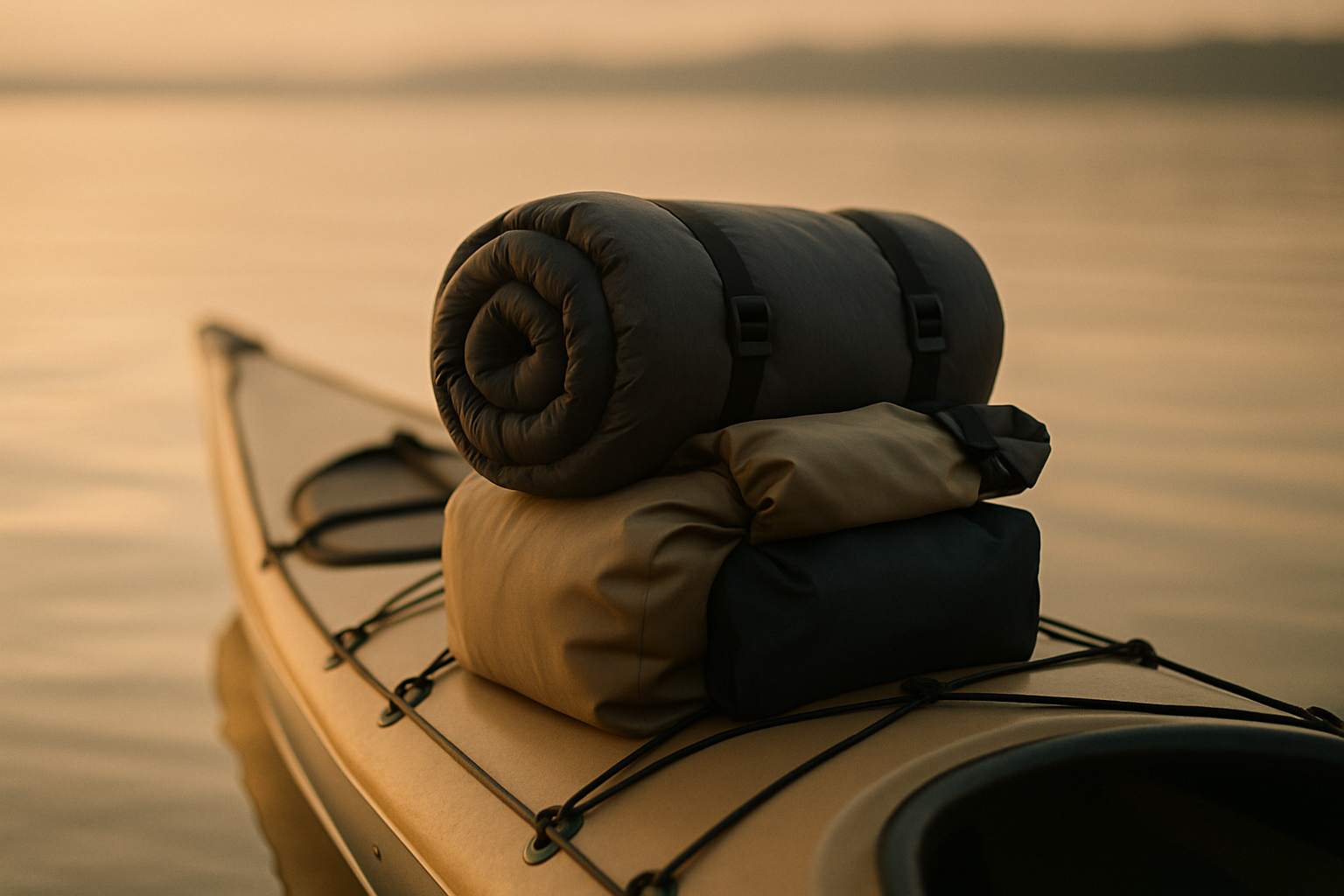
Roll the bag tightly (not stuffed — rolled), strap it with a compression strap or cord, and pack it in a waterproof dry bag. Don’t compress it more than necessary; over-compression damages the insulation permanently.
For a three-season trip, your bag and pad together should fit in a 20–25 liter dry bag. If they don’t, you’ve either chosen bags that are too bulky for kayak camping, or your dry bag is too small.
Sleeping Bag + Pad System: The Full Picture
Your sleeping bag is only half the insulation equation. A thin foam pad (1–1.5 inches) is waterproof and reliable but bulky; an ultralight inflatable is compact but needs to be protected from punctures and loss of pressure.
For kayak camping, most experienced paddlers pair a compact down bag with a thin foam pad, or an ultralight inflatable pad with a synthetic bag (so if the pad fails, the bag still keeps you warm). The combination matters more than either piece alone.
FAQ
Q: Can I use a backpacking sleeping bag for kayak camping?
A: Yes, but it’s not ideal. Backpacking bags are designed for weight distribution on your back, not for hull packing. They’re often bulkier than compact kayak bags and don’t compress as well. If you already own one, it’ll work fine for an overnight trip. For multi-day paddling, a compact bag is worth the investment.
Q: How do I dry a wet sleeping bag on a multi-day trip?
A: If it’s synthetic, hang it in the sun and breeze during the day — most owners report 6–12 hours of sun dries it completely. If it’s down, lay it flat in the sun and gently fluff it by hand every hour or so. Don’t pack a wet down bag; it will mildew. If you can’t dry it, sleep in your clothes and use the bag as a blanket over you, not under you.
Q: What’s the actual temperature I’ll sleep at with a 20°F bag?
A: Assume 25–30°F comfortably, depending on your pad and clothing. Below that, you’ll be cold. Temperature ratings are conservative, but they assume you’re warm-blooded and wearing a base layer.